
This project was carried out as part of our UXD1 course at the University of Technology of Compiègne, during the spring semester of 2025. Coming from diverse academic backgrounds, each member of our 3-student team contributed different strengths, allowing us to share responsibilities evenly.
Concerts and festivals are moments of festivity and collective energy ; but for many, they also trigger anxiety. Dense crowds, limited exits, and the fear of being unable to move or find friends can quickly turn excitement into panic.
LightCrowd is a hybrid system designed to make these experiences safer and more manageable, by combining a physical bracelet and a digital mobile app. The bracelet uses light and haptic signals to help users indicate distress to those around them, while the app allows users to signal their intention to reunite with friends, as well as providing additional contextual information (venue exits, crowd density, group location…).
We aimed to go beyond simply preventing and treating panic on the individual level, instead creating an opportunity for collective care and community.
After refining the scope from a broad study of mental health and agoraphobia (which proved too clinically complex for our initial focus), we pivoted to exploring the more universal experience of anxiety within high-density environments, specifically concert pits.
Our discovery phase combined desk research on crowd dynamics and science, along with a quantitative online survey of over 60 respondents in order to identify common coping mechanisms, such as the use of meeting points and visual signals, as well as the significant impact of height on the individual experience. To validate these findings, we conducted field observations and interviews at a Maluma concert in Paris, grounding our data in real-world behaviours and environmental stressors.
Through our research, two major user concerns stood out :
As we converged, it became clear that our solution needed to be both immediate and effortless : something users could activate in the moment, even under stress. That’s why we centred our concept around a connected bracelet, a simple and wearable device always within reach.
Two key functions immediately emerged as essential : an alert mode to exit the crowd, and a group mode to reunite with friends. To support these, we mapped out the information architecture and user flow, directly linking bracelet and app interactions. This helped us ensure that both physical and digital components complemented each other seamlessly.
To address the need for an immediate and effortless solution under stress, we converged on a connected bracelet as a wearable, always-accessible device. The core concept focuses on two essential functions, both developed through a structured information architecture and user flows that seamlessly linked physical and digital interactions : an alert mode for exiting the crowd, and a group mode for reuniting with friends.
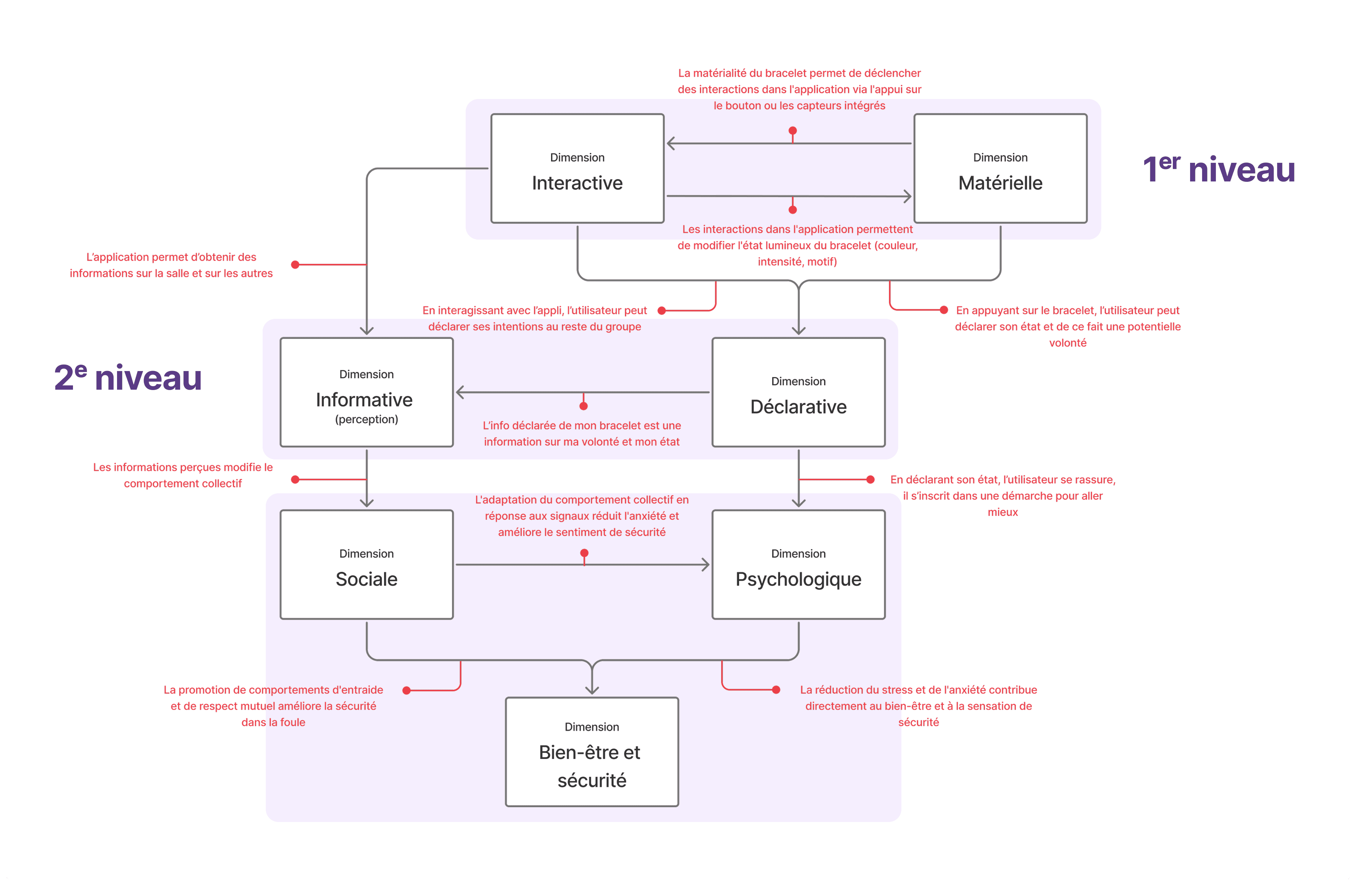
Dimensions
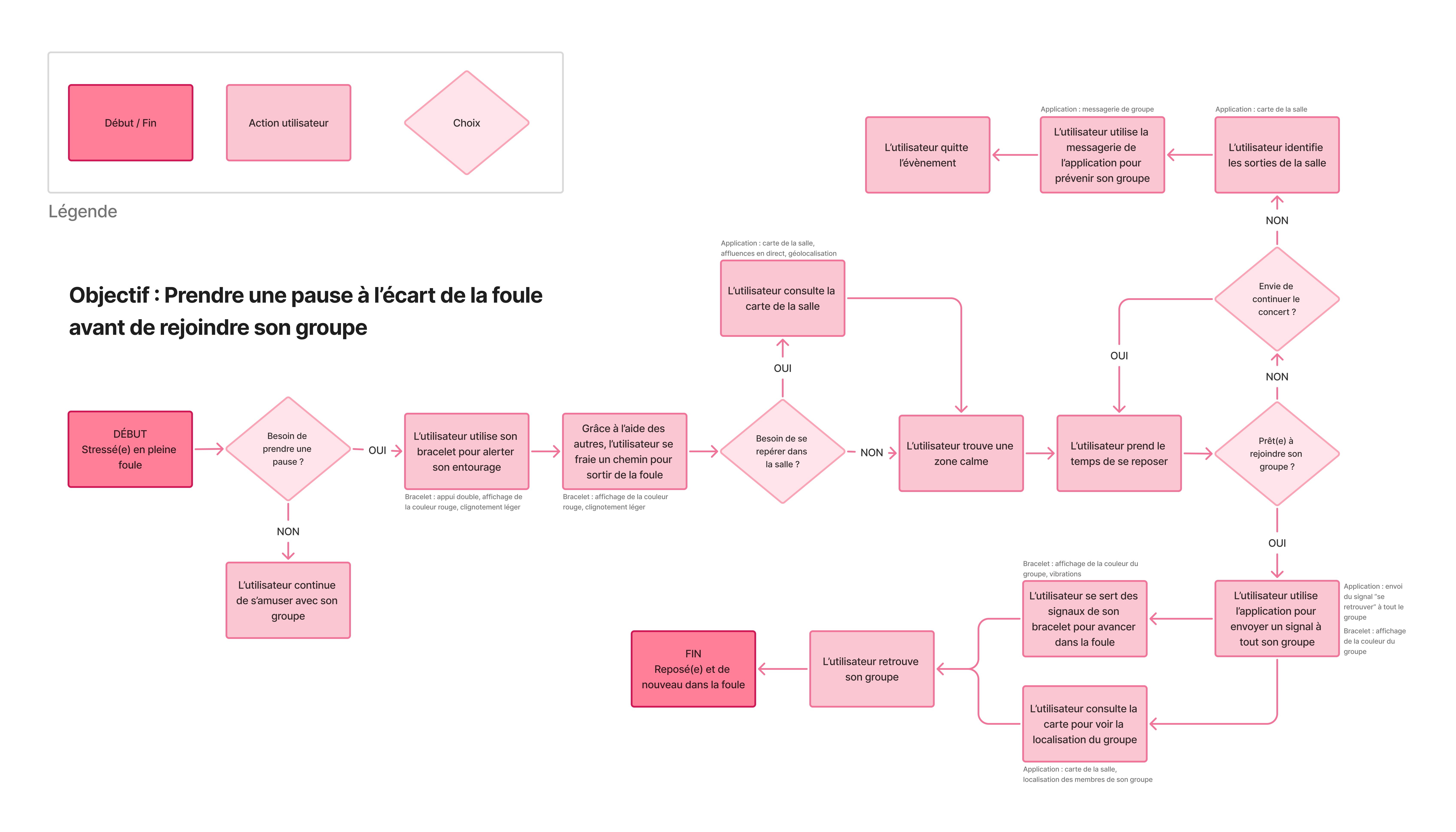
User flow
Following our research phase, two distinct user profiles emerged :
Zoé, short in size, who enjoys concerts but often feels the need to take breaks due to anxiety.
Étienne, tall, who embraces crowds, takes care of his friends and acts as a natural point of reference for his group.
We tested our rough initial concept through a storyboard scenario starring our two personas Zoé and Étienne, following the format of a 5-second test in order to assess participants’ understanding of how the device worked, their perceived interest on both personal and collective scales, anticipated limitations, as well as suggestions for improvement. Participants understood the concept and found it reassuring, but raised doubts: Would the light signal be visible in the chaos of a real concert? Would others actually react? Could the bracelet be abused?
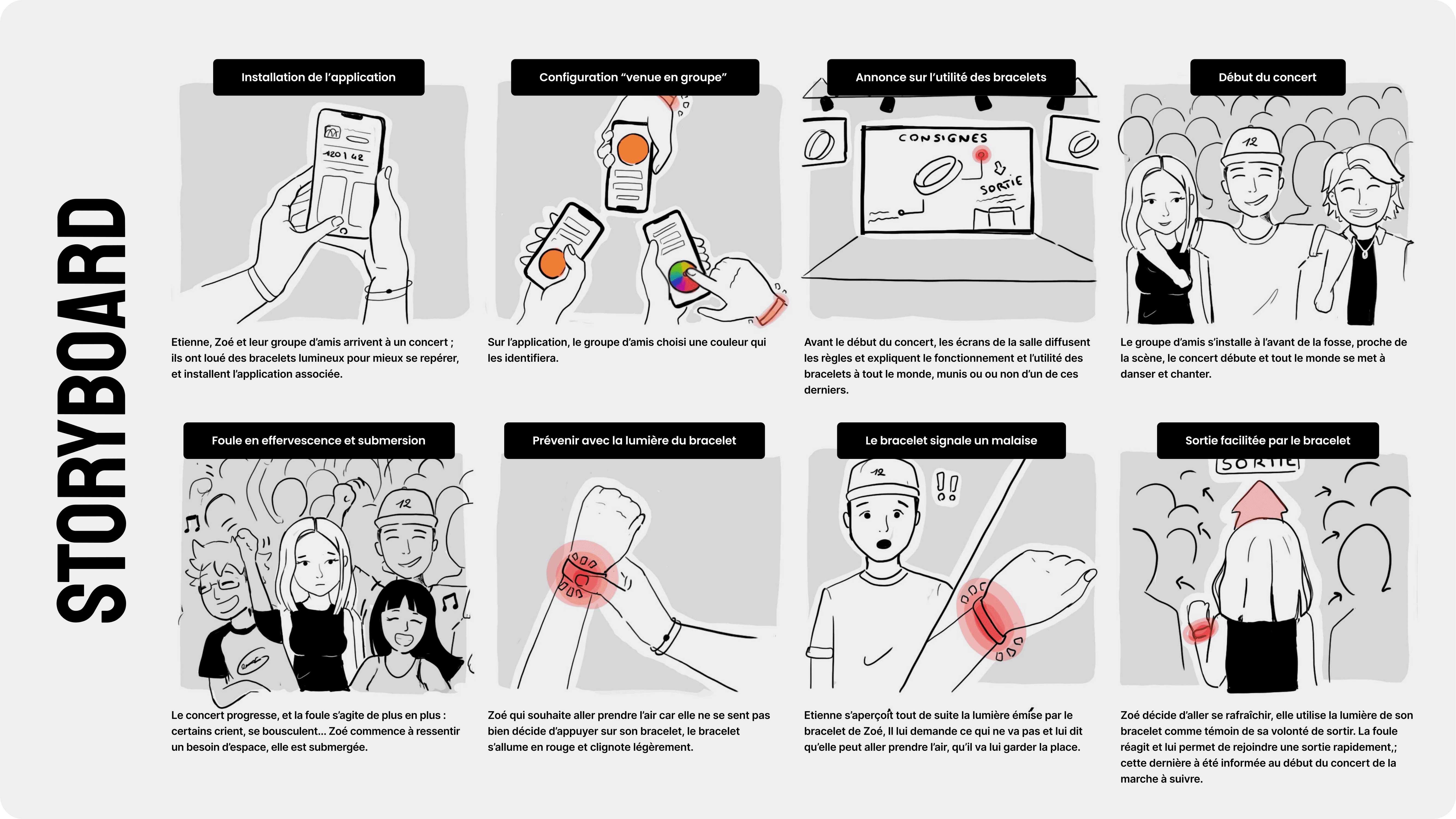
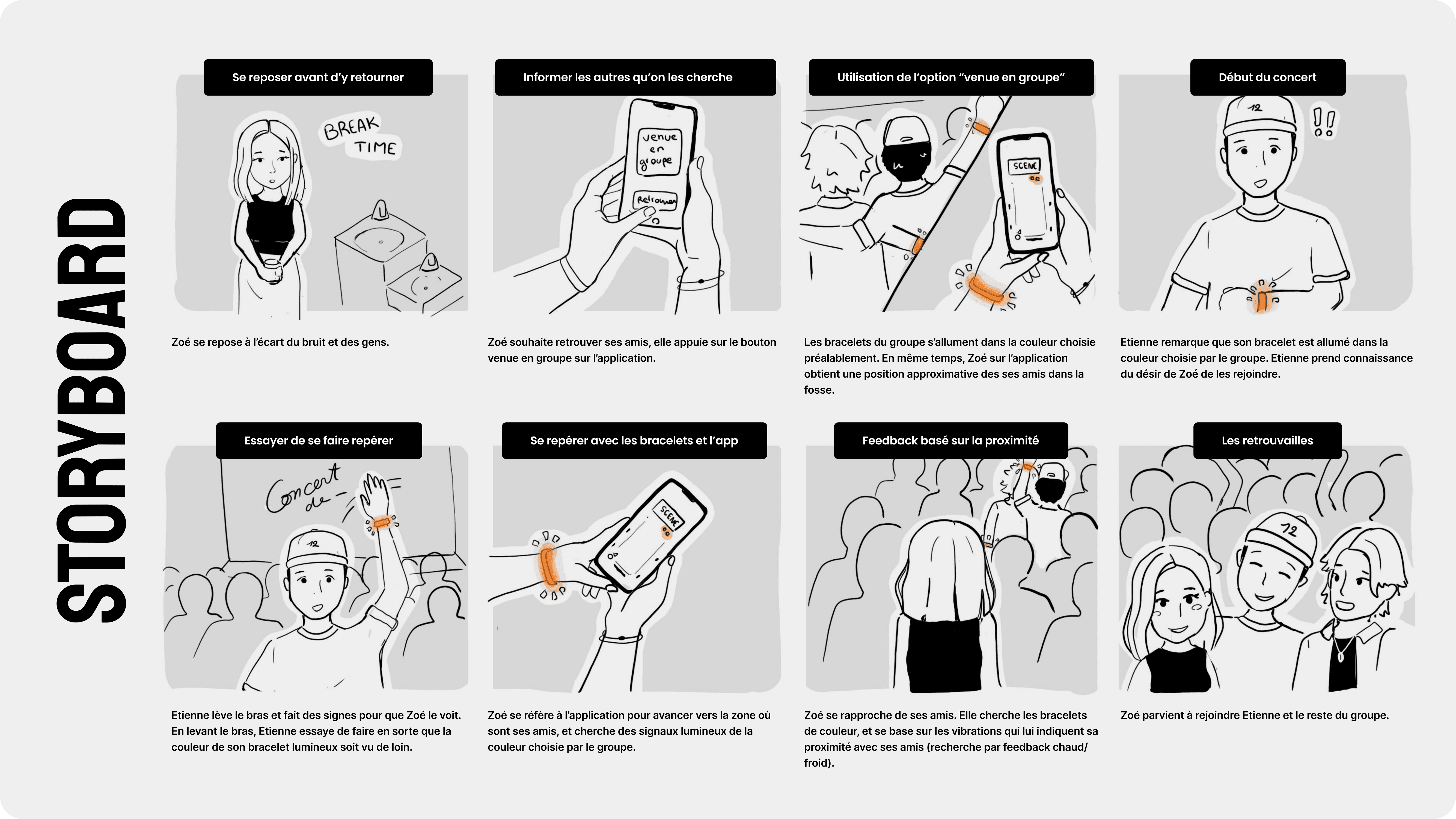
Our proposed solution, LightCrowd, consists of a connected bracelet paired with a mobile app.
The bracelet is designed for instinctive use even under stress: a long press triggers alert mode, displaying a red light through an animation designed to mimic the crowd parting to make way for the user.
Through the app, users can activate group mode, lighting up their bracelets in a previously configured group colour, and using haptic feedback as a tactile compass to guide them back together. The app also provides a map of exits, group locations, and crowd density, with quick access to essential actions.
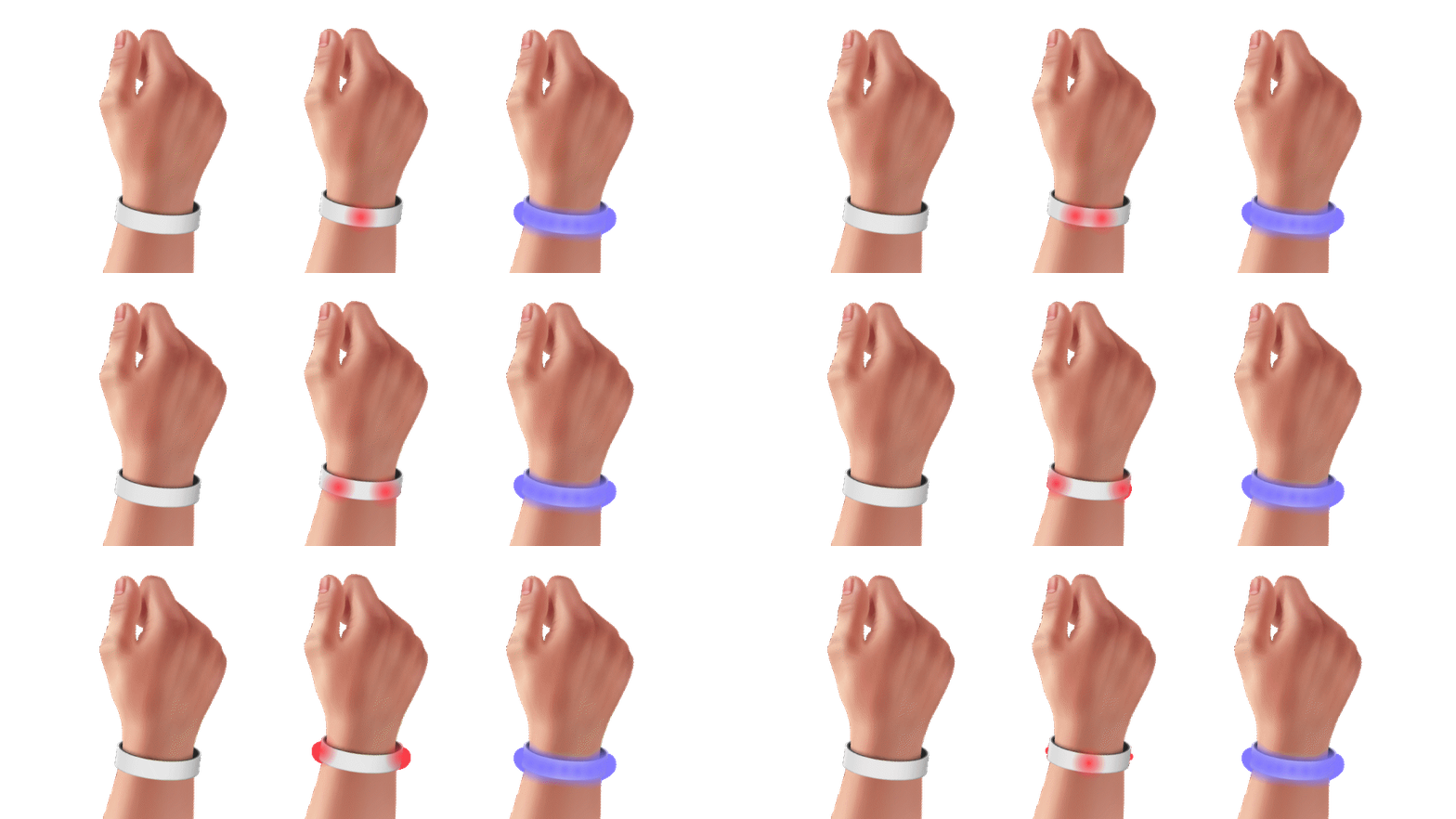
Default state
Alert state
Regroup state
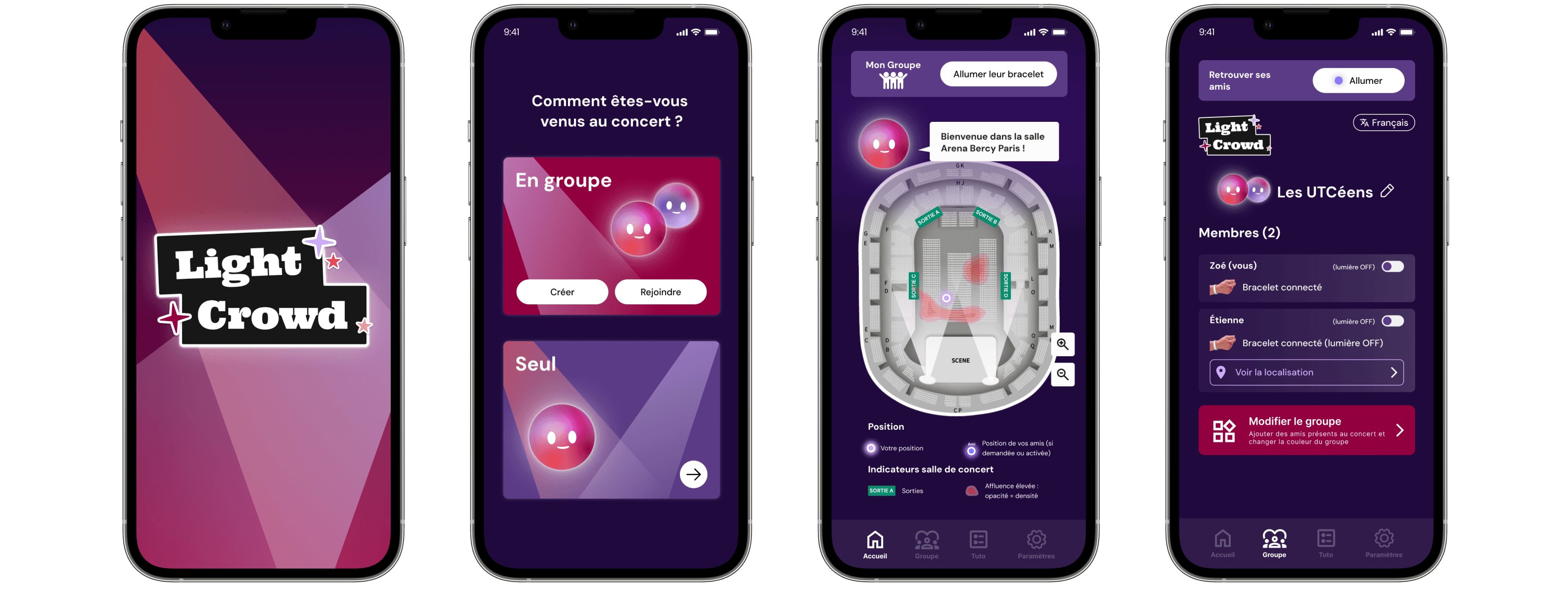
App screens
LightCrowd relies not only on technology, but also on collective understanding. For the bracelet’s signals to work, spectators present within the crowd must recognise and respond to them, even if they aren’t wearing a bracelet themselves. This is why we imagined a communication strategy across multiple touchpoints :
Before the event : clear information on tickets, confirmation emails, and social media.
At the venue : signage and a staffed rental booth to assist setup and answer questions.
During the concert : a pre-show announcement reminding everyone of the alert signal.
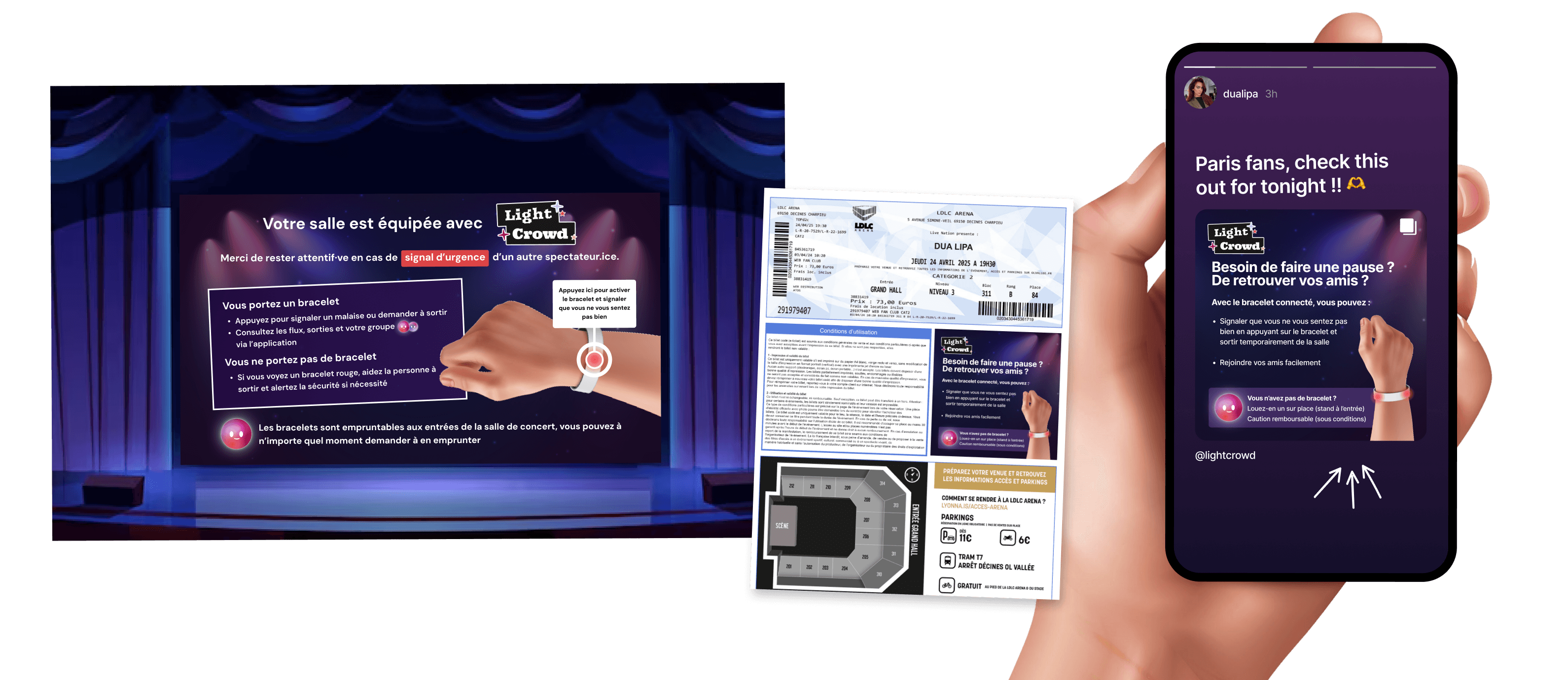
Communication strategy mockups
Accessibility guided our design decisions every step of the way : simple signals to avoid overload, animations that go beyond colour to aid visibility, long-press activation with haptic confirmation to prevent mistakes, as well as three complementary reunion channels (light, haptics, and geolocation).
As for visual identity, we drew inspiration from the pop-rock festival aesthetic, with purple tones evoking creativity, transition, and calm. We also created luminous mascots, abstract figures symbolising the individual within the collective mass of a crowd.
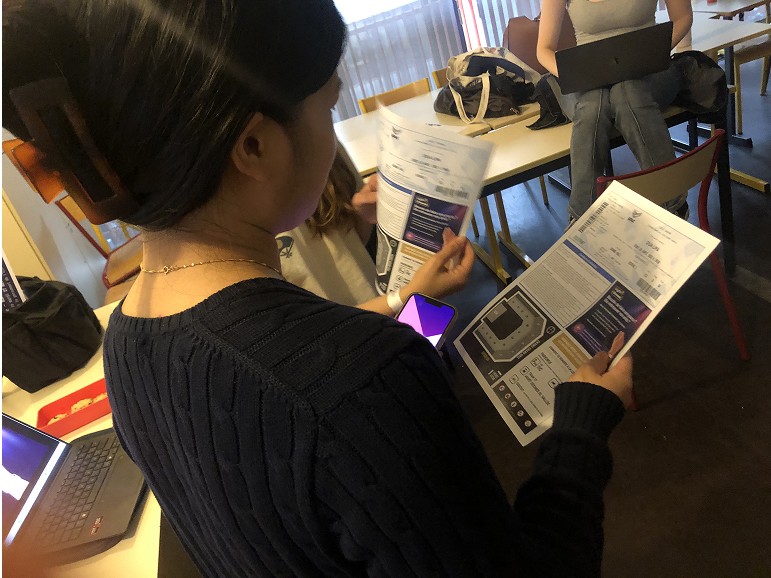
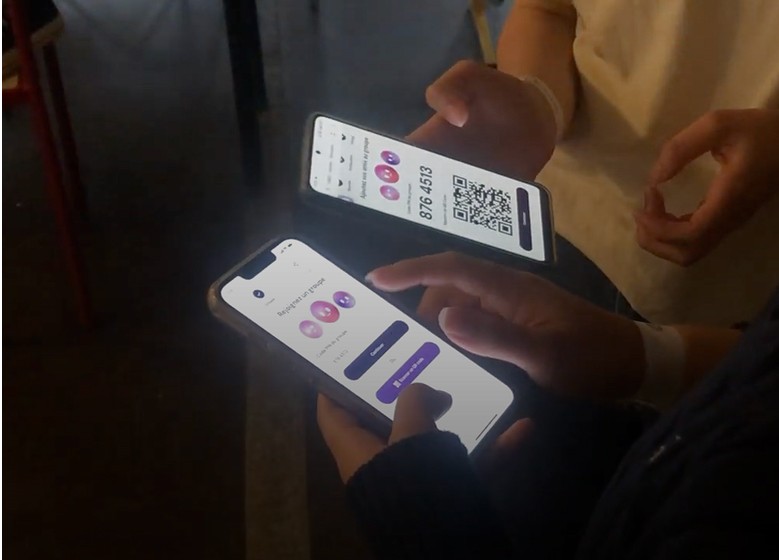
Testing our device within its intended environment, a live concert crowd, proved to be unrealistic at our level. In order to get around this issue, we decided to create a simulation. We crafted paper prototypes of bracelets, transformed a classroom into a pseudo-concert environment (dark room, lights, sound, video), and created an interactive scenario mixing live role-play and on-screen instructions. Participants were tasked with navigating a mini-concert: configuring their bracelet, enjoying the event, signalling distress when discomfort appeared, leaving the crowd, and eventually reuniting with a friend.
The first session helped validate interest, but exposed issues with maintaining immersion. For the second session, we refined the setup and provided additional narrative context, which significantly improved engagement. Participants better understood the functions, projected themselves more easily into the experience, and gave richer feedback as a result.
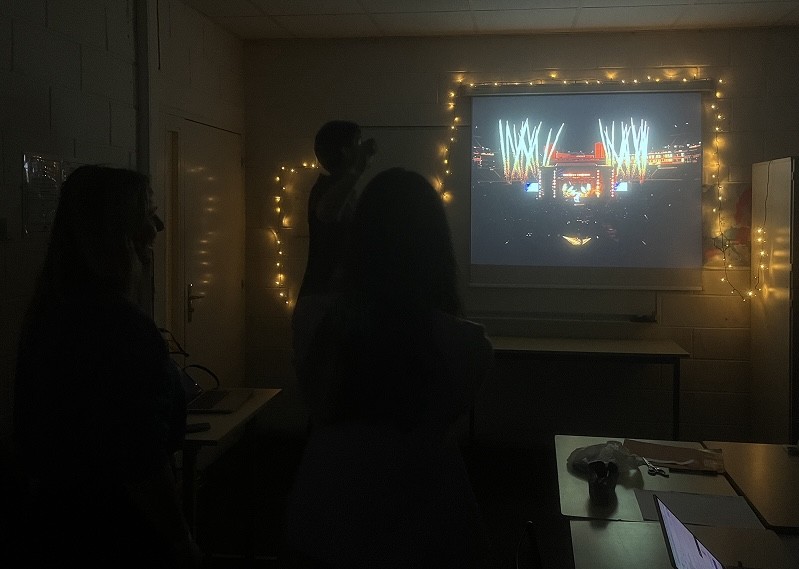
User testing
Looking back, one of the biggest lessons we learned was the importance of timing and resources in physical prototyping. We greatly underestimated the complexity of working with our university's conception lab and the technical skills needed for assembly, which limited how far we could push the bracelet prototype. On the plus side, we learned how to adapt quickly : shifting testing protocols, using role-play, and focusing on creating an immersive experience even in the absence of a polished device.
Another key takeaway is the necessity for collaboration. For LightCrowd to succeed in reality, it requires buy-in from concert venues and music artists as much as from the users themselves. This interdependence between design, technology, and cultural adoption became one of the project’s most valuable insights.