
Our starting point was the broad topic of students’ relationship to nature in 2030, which initially led us to experiment with biophony, the sounds of living organisms. We created and tested a sound lottery game where participants were tasked to identify animal calls, hypothesizing that rural students would outperform urban students. Results were inconclusive, and we realized this approach was too narrow.
Pivoting, we created an exploratory questionnaire with immersive soundscapes (markets, countryside mornings, campus noise) played through headphones. Unexpectedly, students’ descriptions often referred to campus locations, especially the university restaurant (RU) whenever audio clips were described as unpleasantly noisy.
This suggested that anthropophony was a stronger issue than the absence of natural sounds.
Through semi-structured interviews, two key user types emerged, which we used to create our personas :
Aurore, highly sensitive to noise, who seeks calmer environments.
Thomas, less sensitive, who enjoys social energy but unconsciously contributes to the noise.
Scenarios built around these personas helped us visualise how each experienced the same soundscapes differently, underlining the need for flexible solutions.
To further ground our research, we conducted field observations and created a sound map of campus, recording audio across different locations. The canteen consistently emerged as the loudest space, with noise levels peaking above 90 dB (comparable to that of heavy traffic), which supported students’ complaints.
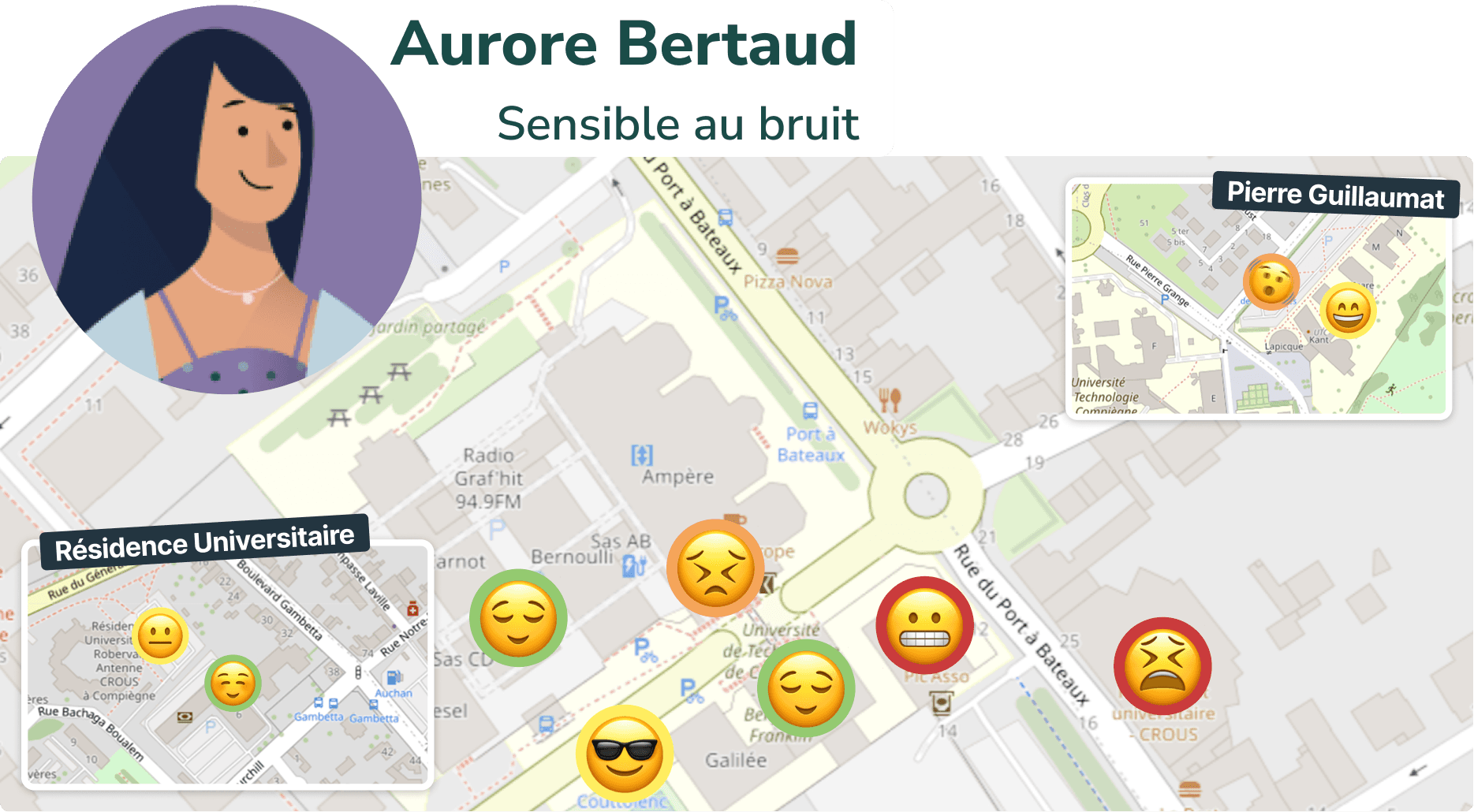
Aurore's user journey map
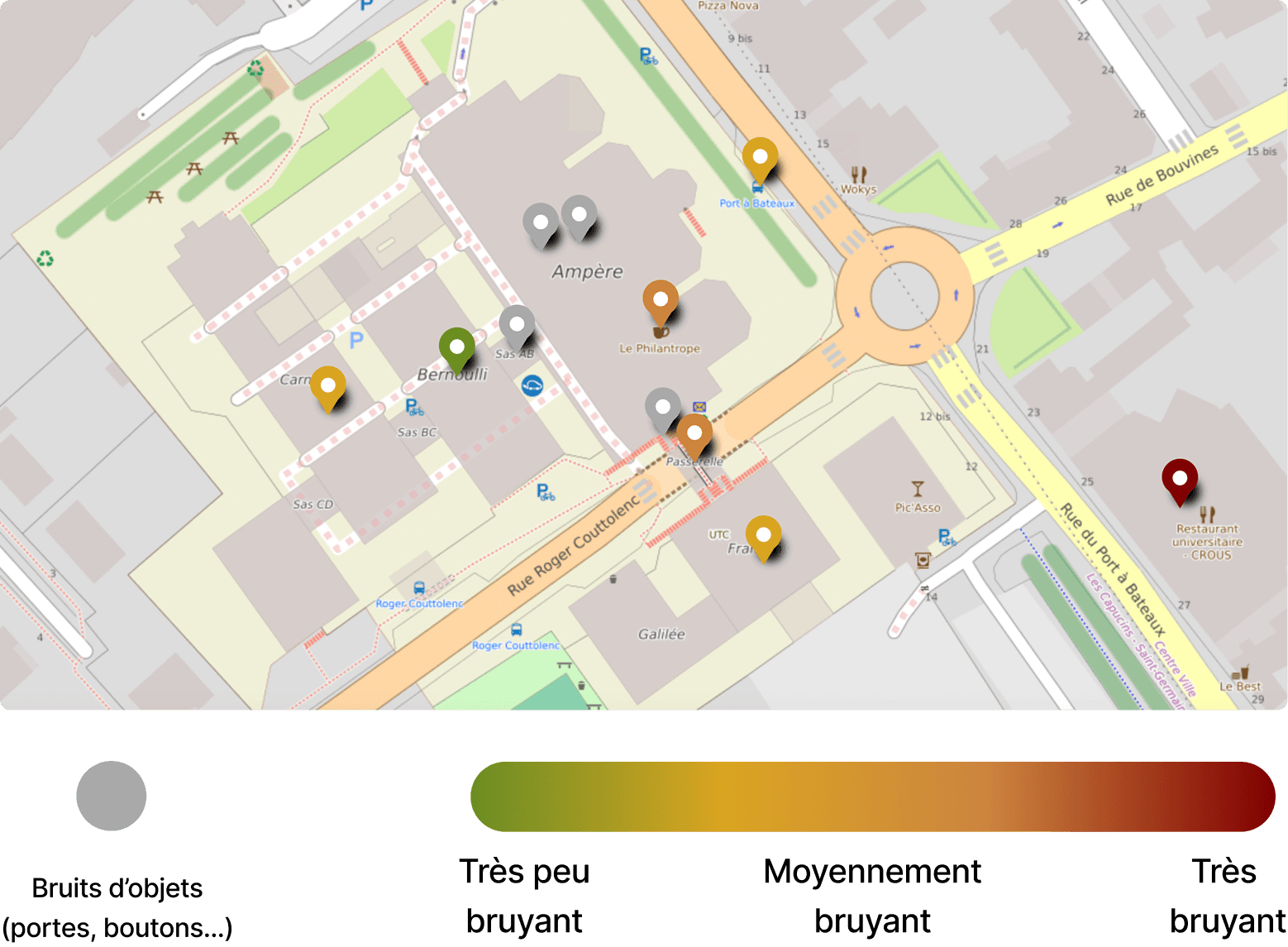
Campus sound mapping
In order to thoroughly explore possible solutions, we organized our first co-creation workshop with students.
It unfolded in two phases, over the course of two hours.
In the first phase, participants were asked to imagine an ideal “sensorial break” space on campus, without constraints of budget or realism. Additionally, each participant randomly drew a card representing a fictional character with a unique auditory sensitivity. This roleplay sparked original and extreme ideas, encouraging participants to push beyond conventional solutions.
In the second phase, we refocused on feasible interventions. Each participant suggested a concrete idea, then placed it on a matrix balancing relevance to the problem against complexity and originality. Voting followed with stickers: one for the most feasible idea, and one for their personal favorite.
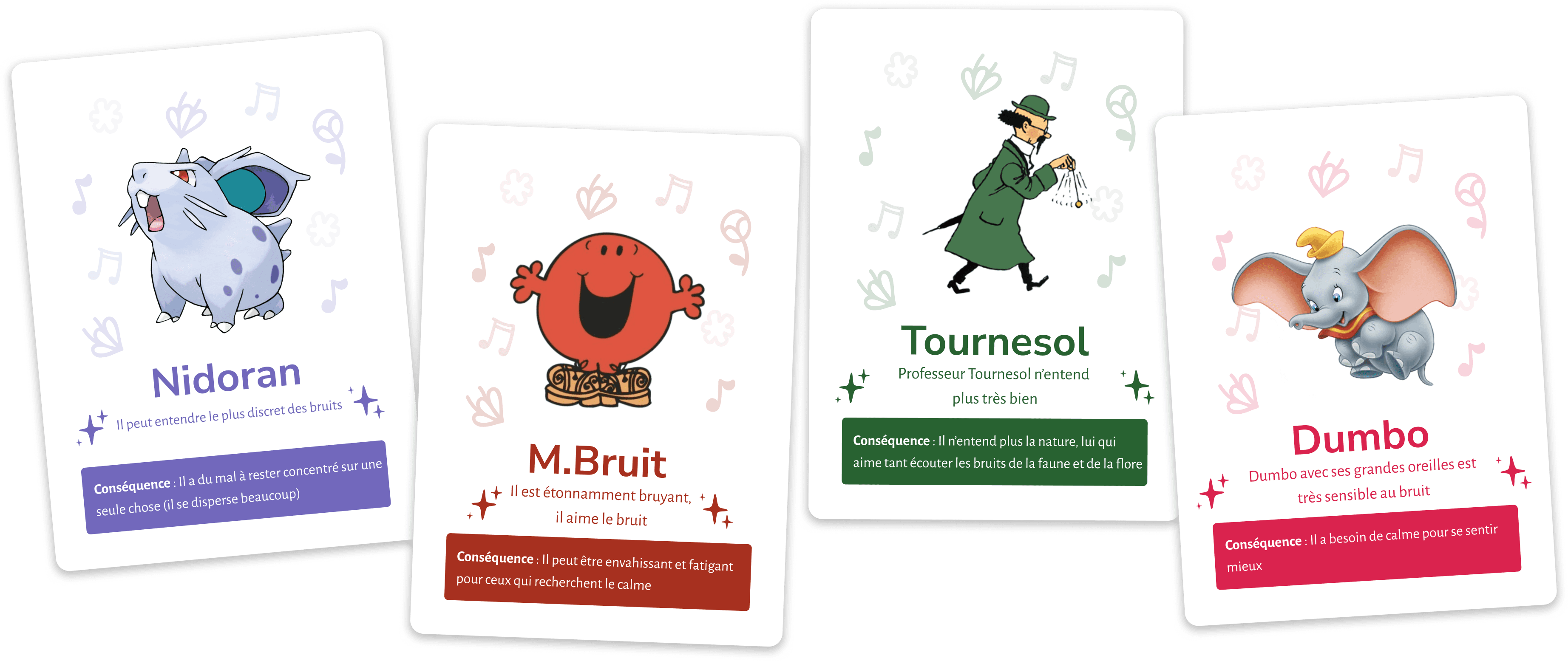
Character cards
The workshop generated a wide range of ideas. The idea voted as most feasible was a Japanese-style water fountain, providing soothing background sound. The group's favourite was acoustic zoning : dividing the canteen into quiet, moderate, and lively areas. Other proposals included green walls to absorb sound, furniture reconfiguration, and “whisper corners.”
Feedback about our workshop approach highlighted confusion about the exact direction of our project, pushing us to further clarify the problem we were trying to solve.
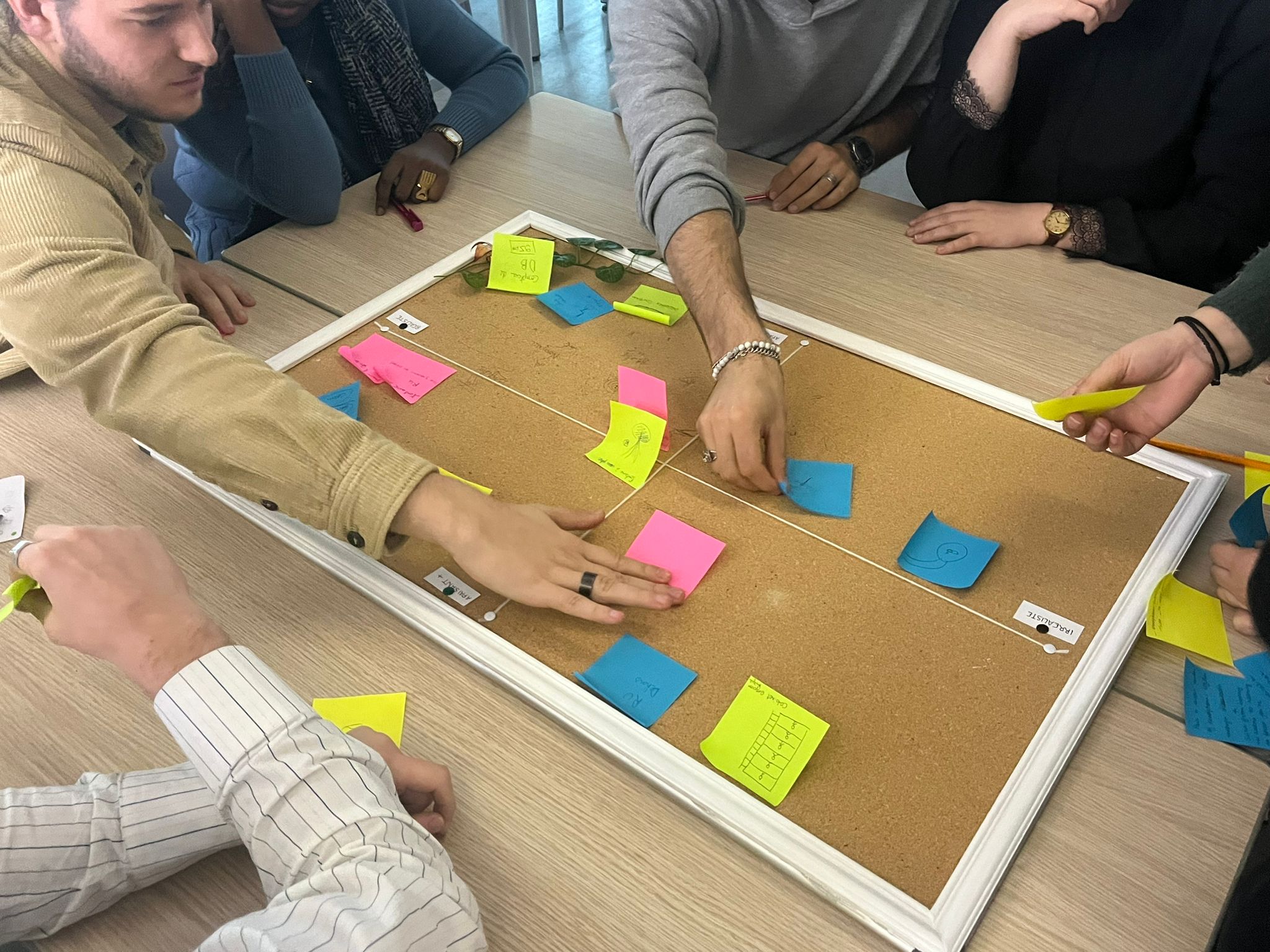
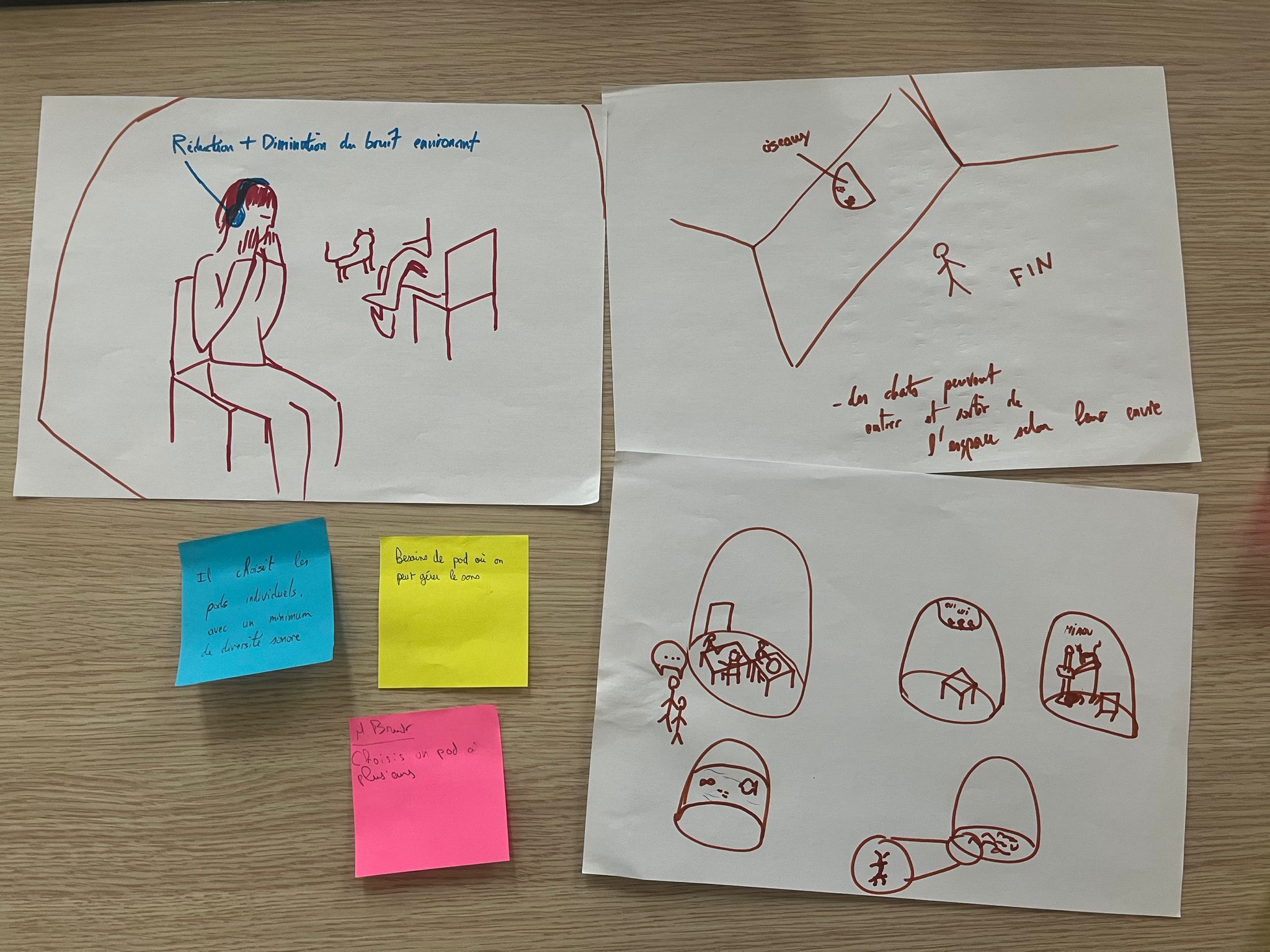
Ideation workshop
Coming out of our ideation workshop, we were prompted to pause, take a step back, and clarify the core issue we truly wanted to address. Initially, our question was : “How can we reintroduce natural sounds during lunch?”
However, students resisted artificial “nature sounds” (like birdsong), describing them as fake and unsuitable.
As such, we reframed the challenge to focus on real needs :
From this convergence, we developed a solution combining acoustic zoning with interactive vegetal design.
Ground floor : lively but moderated
The main dining hall hosts the majority of students and remains lively, but noise is moderated by vegetal sound walls, dense arrangements of plants with acoustic properties. Integrated into these walls are mechanical flowers linked to sound sensors. When noise stays within acceptable limits, the flowers bloom open; when it rises too high, they slowly close into buds. This creates a collective, non-verbal feedback system that encourages self-regulation without shaming individuals.First floor : calm zone
Upstairs, students seeking quiet are able to eat in a calmer environment. Here, each table features a single flower under a glass dome, acting as a localised soundometer. Conversations remain possible, but if noise rises, the flower closes gently, reminding groups of their impact. This creates a quieter environment without directly policing silence or creating guilt.
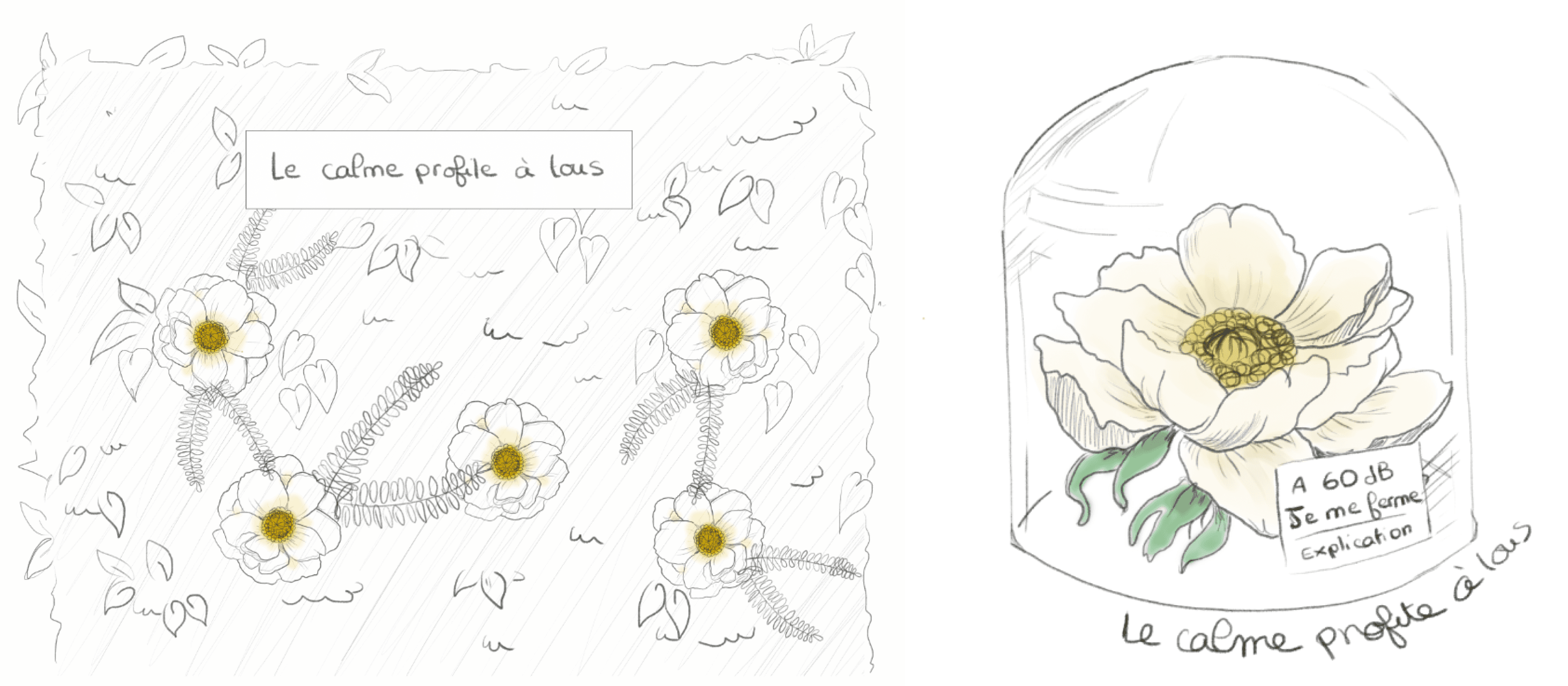
Ground floor
First floor
We built a paper prototype flower with a simple mechanical opening–closing system to simulate sound feedback. The model used a sliding ring along the stem connected to the petals with thin strips of paper: when the ring was pushed down, the petals spread open, and when pulled back up, they folded back into themselves. This allowed us to physically demonstrate how the flower could respond to sound levels in real time.

Paper prototype
Tests conducted in the canteen showed mixed reactions : many students found the flower engaging and less guilt-inducing than digital meters. However, some also believed that while this solution might be effective for a short time, students would eventually get used to the flowers and stop paying attention to them. Overall, students strongly supported the idea of separating calm and lively zones.
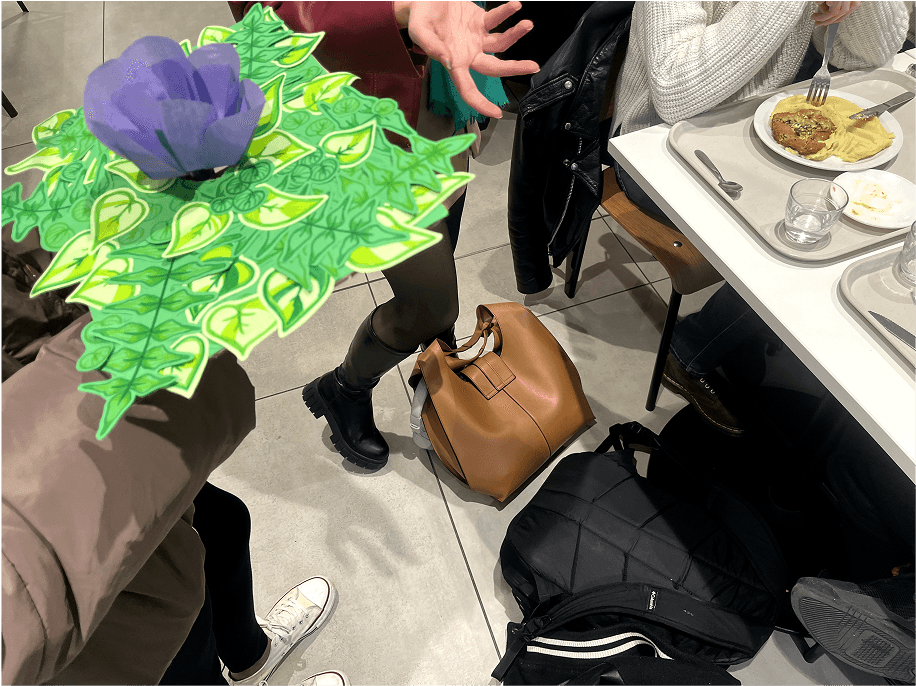

User testing
The project highlighted a paradox : students do not explicitly desire more natural sounds, yet they long for calmer, more pleasant environments where sound is better managed. As such, nature-based design elements (plants, flowers) became meaningful not as simple decorative additions, but as mediators of acoustic well-being.
Open questions remain :
How can we prevent interactive elements from being seen as gimmicks?
How can we implement acoustic zoning in limited spaces without reinforcing social divisions?
How might these solutions scale to other communal university spaces?
Our work suggests that rethinking anthropophony is not about silencing human voices, but about designing conditions where they can coexist harmoniously with well-being and attention to sound.